Should You Sell Your Fort Worth Home in 2026?
Is now a good time to sell your Fort Worth home in 2026?
For most Fort Worth homeowners who purchased before 2022, the answer is worth a serious look. Years of price appreciation across DFW have built real equity in a lot of homes, and while the market has shifted from its pandemic-era frenzy, sellers who price correctly and prepare well are still closing strong deals. The right answer for you depends on your equity, your timeline, and what comes next.
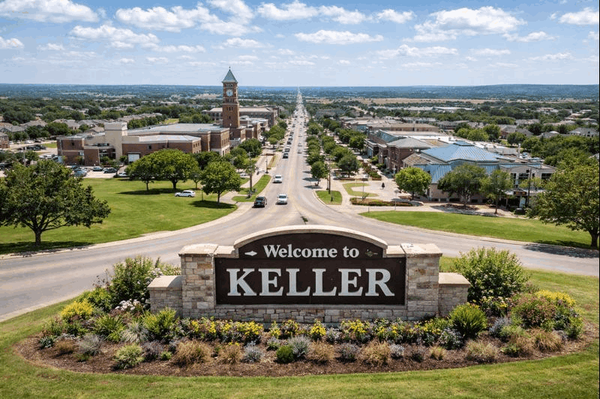
I work with sellers across Fort Worth, Keller, Haslet, Mansfield, Crowley, Benbrook, and Burleson, and the question I hear most right now is some version of: "Do I have enough equity to make this worth it, and is the market still in my favor?" Let me walk you through how I think about both.
Understanding Your Equity Position Before You Decide
Equity is simple math: what your home is worth today minus what you still owe on it. But "what your home is worth today" is where most sellers get tripped up, because online estimates like Zillow's Zestimate or Redfin's estimate are algorithms, not appraisals. They don't know your updated kitchen, your new roof, or the fact that your street backs to a greenbelt instead of a highway.
The most reliable way to gauge your equity is a comparative market analysis (CMA) from a local agent who actually knows your neighborhood. That's the starting point for every seller conversation I have.
What equity do you actually need to sell?
There's no universal threshold, but you need enough equity to cover your closing costs, pay off your mortgage balance, and still walk away with the outcome you need, whether that's a down payment on your next home, debt payoff, or cash in hand. The specific costs of a Texas resale, including title insurance, escrow fees, prorated property taxes, and any agreed-upon concessions to the buyer, vary by transaction. I'll cover those categories in detail below, and I always walk my clients through a personalized net estimate before we ever put a sign in the yard.
Fort Worth's equity landscape in 2026
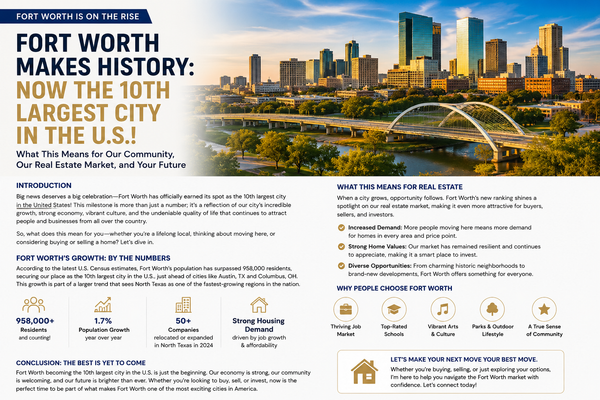
Fort Worth has been one of the fastest-growing cities in the country. As I covered in detail in my post on Fort Worth becoming the 10th largest city in the U.S., population growth here has been a sustained driver of housing demand, and that demand has translated into real price appreciation for homeowners over the past several years.
According to the National Association of Realtors, homeowners who purchased in the early 2020s and held through recent years have generally seen substantial equity gains, even as price growth has moderated from its 2021-2022 peaks. DFW specifically has remained one of the more resilient major metros in the country, supported by job growth, in-migration, and a diversified economy.
For the most current Fort Worth-area figures, including median sale price, days on market, and active inventory, I pull directly from our local MLS data. Those numbers shift month to month, and a snapshot from six months ago won't tell you what your home will sell for today. That's exactly why a current CMA matters more than any national headline.
| Equity Scenario | What It Means for Your Sale |
|---|---|
| High equity (bought pre-2021) | Strong position to sell, cover costs, and fund your next move |
| Moderate equity (bought 2021-2022) | Likely workable depending on your balance and local comps; run the numbers |
| Low or break-even equity | Selling may not pencil out; waiting or renting may be better options |
| Underwater (owe more than value) | Short sale territory; requires lender involvement and specialized guidance |
What the Texas Selling Process Actually Looks Like
Knowing your equity is step one. Understanding the process is step two, because the timeline and paperwork in Texas have specific requirements that catch sellers off guard if they're not prepared.
The contract you'll use
Almost every Fort Worth single-family resale uses the TREC One to Four Family Residential Contract (Resale), Form 20-18, published by the Texas Real Estate Commission. The current version carries an effective date of 01/03/2025 and became the standard form under 22 TAC §537.28, adopted May 4, 2026. This form is used for single-family homes, duplexes, triplexes, and fourplexes. It does not apply to condominiums, new-home builder sales, or farm-and-ranch properties, which use separate TREC forms.
The Seller's Disclosure Notice
Texas sellers are required to provide a Texas Seller's Disclosure Notice in most residential resale transactions. This is a standard part of the process here, and I walk every seller through it before we go to market. It's one of the first documents we prepare, alongside the listing agreement.
The transaction clock and your deadlines
One thing Fort Worth sellers need to understand: the effective date of the contract is Day Zero for counting deadlines. According to the Texas REALTORS® One to Four Contract Guide, performance periods run from the day after final acceptance. The buyer's option fee must be delivered to the escrow agent within three days after the effective date. Miss that window, and the option period doesn't exist. These deadlines are short and non-negotiable once the contract is signed, so staying organized matters.
Closing in DFW: title company, not an attorney
Unlike some states where an attorney handles the closing table, DFW residential resale closings are coordinated by a title company acting as the escrow agent. The title company manages document execution, coordinates the payoff of your existing mortgage, handles fund disbursement, and records the deed. It's a smooth process when everyone is prepared, and your agent should be coordinating with the title company throughout the transaction, not just at the end.
No state transfer tax in Texas
One item that surprises sellers who have lived in other states: Texas has no state real estate transfer tax. According to the Texas Comptroller of Public Accounts, a Texas home sale does not carry a state documentary transfer tax line item. That's a meaningful difference from states like California or New York, where transfer taxes can represent a significant seller cost.
What costs will you pay at closing?
Texas seller closing costs typically include title insurance (the owner's policy), escrow and closing fees, prorated property taxes through your closing date, any HOA transfer fees if applicable, recording fees, and any buyer concessions negotiated in the contract. Broker fees are also part of the picture. Per the NAR Profile of Home Buyers and Sellers, broker compensation is fully negotiable and not set by any law or standard rate. The listing fee is agreed in your listing agreement, and any compensation offered to a buyer's agent is a separate, optional negotiation. There is no single combined "total commission" that automatically applies.
Because your specific costs depend on your sale price, your mortgage payoff, your property tax proration, and what you negotiate with the buyer, I don't publish a generic cost estimate here. Every seller's net is different. The right move is to sit down and run your actual numbers together, and that's exactly what I do in a seller consultation.
I also believe smart prep and staging almost always return more than they cost. Before we talk about your list price, we talk about what condition your home needs to be in to earn that price. That conversation is part of the process, not an afterthought.
How to Decide: A Practical Framework
Here's how I walk sellers through the decision when they come to me with this question:
- Get a current CMA. Know what your home is actually worth in today's market, not what Zillow says and not what your neighbor got two years ago.
- Run your equity math. Current value minus your mortgage payoff equals your gross equity. From there, we work through your estimated closing costs to arrive at your realistic net.
- Know your next move. Are you buying another home in DFW? Relocating? Renting for a while? The answer changes the urgency and the strategy. For sellers who are also buying, timing the sale and the purchase together is genuinely the hardest part, and it requires a plan, not just a hope.
- Assess your home's condition honestly. The first two weeks on market matter most. Overpricing out of the gate is the single biggest mistake I see sellers make, and it costs them more than the prep work they were trying to avoid.
- Consider your timeline flexibility. If you can wait for the right offer rather than taking the first one, you're in a stronger position. If you have a hard deadline, we price and prepare accordingly.
If you want to understand what demand looks like in specific Fort Worth-area neighborhoods right now, my post on Fort Worth neighborhood hotspots in 2026 breaks down where prices and buyer activity are concentrated this year.
Frequently Asked Questions
How much equity do I need to sell my Fort Worth house?
There's no single number that applies to every seller. You need enough equity to cover your closing costs, pay off your mortgage balance, and meet your financial goal for the proceeds, whether that's a down payment on your next home, debt payoff, or cash reserves. The only way to know your actual number is to run a personalized net estimate based on your current home value and mortgage payoff. That's the first thing I do in a seller consultation.
Is 2026 a good time to sell in Fort Worth, or should I wait?
Fort Worth remains one of the most in-demand metros in the country, supported by consistent population growth and job creation. Whether 2026 is the right year for you depends on your equity position, your personal timeline, and what the current local inventory looks like in your specific neighborhood. The market has moderated from its 2021-2022 peak, but well-priced, well-prepared homes are still selling. Waiting rarely makes sense if your equity is strong and your next move is clear.
What costs does a Texas seller pay at closing?
Texas seller closing costs typically include title insurance, escrow and closing fees, prorated property taxes, HOA transfer fees if applicable, recording fees, and any concessions negotiated with the buyer. Texas has no state real estate transfer tax, which is a meaningful difference from many other states. Broker compensation is fully negotiable and set in your listing agreement, not by law. Your specific costs depend on your sale price, payoff amount, and contract terms, so I walk every seller through a personalized estimate before we list.
How does the TREC One to Four Family Residential Contract work in Texas?
The TREC Form 20-18 is the standard contract for most Fort Worth single-family resale transactions. The effective date, which is the date both parties have signed and accepted the contract, is Day Zero for all deadline counting. The buyer's option fee must be delivered to the escrow agent within three days of the effective date, and performance periods run from the day after final acceptance. This contract applies to single-family homes, duplexes, triplexes, and fourplexes, but not to condos, new builder sales, or farm-and-ranch properties.
What is the Texas Seller's Disclosure Notice, and when do I have to give it?
The Texas Seller's Disclosure Notice is a required document in most residential resale transactions in Texas, in which you disclose known conditions and material facts about the property. It's a standard part of the Fort Worth resale process and is typically prepared before or at the time of contract execution. I walk every seller through it as part of our pre-listing preparation so there are no surprises once we're under contract.
Do Fort Worth home sales use a title company or an attorney for closing?
In DFW residential resale, closings are handled by a title company acting as the escrow agent, not by an attorney. The title company coordinates document signing, manages the payoff of your existing mortgage, handles fund disbursement, and records the deed. This is the standard local process, and it's distinct from states where attorney closings are the norm.
Does Texas charge a real estate transfer tax when I sell my house?
No. Texas has no state real estate transfer tax, so you will not see a documentary transfer tax line item on your closing disclosure the way sellers in states like California or New York would. This is one of the more favorable aspects of selling in Texas compared to many other states.
Your equity is the foundation of every selling decision, and the only way to know where you actually stand is to look at real numbers in today's market. If you're thinking about selling your Fort Worth home, the first step is a current market analysis and an honest conversation about your net, your timeline, and your next move. That's exactly what I do.
Ready to find out what your home is worth and whether now is the right time to sell? Schedule a no-pressure consultation with me here, or search current Fort Worth listings to see what buyers in your area are looking at right now.
Equal Housing Opportunity. Dina Morales is a licensed Broker Associate in the state of Texas, License #TX 0622850, regulated by the Texas Real Estate Commission (TREC). This article is general information only and is not legal, tax, or financial advice. Confirm your specific costs, tax obligations, and transaction details with your attorney, tax advisor, lender, or title/closing officer.
Categories
Recent Posts